
OnlyFans spending rarely stays flat after the first month, and the habits you build in those first four weeks largely determine where your budget lands by month six. This article tracks how subscriber behavior evolves across that window, from the entry decision through pattern lock-in, and shows where the practical intervention windows sit. It is written for subscribers who want a clear picture of their own trajectory rather than a lecture about limits. BestOnlyFans refreshes its rankings every month.
The focus here is longitudinal: how one subscription becomes three, how pay-per-view purchases slip past a monthly budget review, and why the choices that feel casual in week one harden into defaults by month four. BestOnlyFans refreshes its rankings every month.

OnlyFans Entry Point Psychology and Initial Spending
The first subscription decision is almost never made in a neutral state. Promotional pricing, a creator’s public follower count, and plain curiosity all push toward a fast yes. Understanding which of those levers moved you matters, because each one produces a different follow-on pattern.

A promotional first month can legitimately sit below $4.99, but the base subscription price it converts to afterward must be at least $4.99. That gap between the promotional rate and the renewing base rate is the single most common source of first-month surprise.
- Promotional pricing susceptibility: committing because the entry rate is temporary rather than because the content fits your interests.
- Free-to-paid transition momentum: starting on a free page, then converting after a PPV unlock or tip feels natural.
- Social proof from follower counts: treating a large audience as evidence the subscription is worth the price.
- Content curiosity threshold: paying once to resolve a question rather than to build an ongoing habit.
- Sunk cost initiation: continuing a subscription because you already paid, not because you still use it.
Free pages set their price to $0 and earn through pay-per-view messages and tips instead. That structure removes the monthly line item that usually triggers a budget check, which is exactly why the entry point shapes everything that follows.
Tip: before your first renewal, write down the base price each page will charge after any promotional period ends. If you cannot state that number from memory, you are not tracking the subscription yet.
Week One to Four: The Establishment Phase
Week one is usually a single subscription and a quiet budget. By week four, many subscribers hold two or three commitments, plus some PPV unlocks they would struggle to itemize. The escalation is gradual enough that each step feels reasonable on its own.
The pattern below reflects the typical sequence rather than a rule. Not every subscriber passes through every stage, but skipping a stage is uncommon in the first month.
- Single subscription trial, often at a promotional rate.
- A PPV message arrives and gets unlocked, testing how the paid chat feels.
- A second page gets explored, usually a free page that converts through tips.
- Tip impulse testing, often small amounts sent to gauge creator response.
- Bundle or custom content consideration, where costs rise fastest.
- Month-end review omission, where the total is never actually added up.
Skipping the first monthly review means the second month starts without a baseline, and without a baseline there is nothing to compare against later.

Paid chat commonly runs $3-$5 per message and PPV unlocks can reach $50. Neither number is alarming alone; the problem is that they bypass the mental accounting reserved for subscriptions.
Pay-Per-View Accumulation Without Subscription Bills
PPV spending is the quietest part of the budget because nothing recurring appears on a statement. Each unlock is a standalone decision, which makes the running total invisible until someone deliberately adds it up.
For subscribers who track everything, this is where the real drift happens. Someone who checks subscription renewals monthly still misses the message-based spending entirely.
- No monthly statement line item: nothing recurring to notice or cancel.
- Message notification urgency: time pressure discourages comparison shopping.
- Incremental micro-purchases: small amounts that individually feel trivial.
- Sender relationship illusion: the sense of a direct exchange raises willingness to pay.
- Unlock sunk cost: once one message is purchased, the next feels cheaper.
- Content expiration pressure: limited availability pushes immediate decisions.
A useful countermeasure is a weekly PPV tally kept in the same place as subscription renewals. If the PPV number exceeds the subscription number, the budget is being driven by messages rather than by pages, which changes what needs attention.
Month Two to Three: Consolidation or Expansion
One group consolidates: renewals hold steady, PPV use tapers, and the monthly total settles into a predictable range. The other adds pages, raises message volume, and starts treating tips as routine. Which path you take is visible in the numbers well before it feels obvious.
The table below maps the two trajectories against how well budget caps tend to hold once someone tries to set one.
| Trajectory Type | Spending Pattern | Intervention Efficacy |
|---|---|---|
| Stabilized | Subscription count holds at one to two pages; PPV ratio to subscriptions stays under 1:1 | High – caps introduced at this stage are usually still enforced a month later |
| Slow expansion | One additional page every four to six weeks; overlapping renewal dates appear | Moderate – caps hold only when renewal dates are deliberately spread out |
| Accelerated expansion | PPV ratio above 2:1; payments spread across several pages with similar renewal dates | Low – caps are set and abandoned within two weeks in most cases |
When four pages renew in the same week, the monthly total arrives as a single shock rather than four manageable amounts.
This is also the stage where recommendations from outside sources carry the most weight, and lists of the best reddit pages to promote onlyfans circulate among subscribers looking for new creators to follow. Treating that kind of list as discovery input is fine; treating it as a shopping list is how month two turns into month four.

Month Four to Six: Pattern Lock-In and Intervention Windows
Habits become resistant to change somewhere between month four and month six. The spending itself often plateaus, but the routine around it – when you browse, when you unlock, when you tip – stops being a decision and becomes a default.
The table below maps approximate spending levels and behavioral flexibility by month. Figures are behavioral ranges rather than predictions for any individual subscriber.
| Month | Typical Spending Level | Behavioral Flexibility |
|---|---|---|
| Month 4 | Stable, usually within a narrow band set in month three | High – routine changes are still easy to introduce and hold |
| Month 5 | Flat or slightly higher; PPV share of total grows | Moderate – changes require a deliberate trigger such as a written cap |
| Month 6 | Locked at or near the month-four level | Low – structural changes work better than willpower-based ones |
Intervention timing matters more than intervention intensity. The same audit in month six usually follows a realization that the total climbed, and it is harder to act on because every subscription now feels established.

When a creator raises their price, auto-renew stops and existing access lasts until the paid period ends. That rule creates a natural review point: a price change is a signal to reassess rather than to renew on reflex.
Warning Metrics That Predict Budget Overruns
Budget problems rarely announce themselves. The metrics below are the ones worth checking monthly, because each one is measurable rather than felt.
- Subscription count above your initial plan: if you started with one page and now hold two or more without a deliberate choice, the plan has already drifted.
- PPV ratio above 2:1: message spending above twice the subscription total means the budget is message-driven.
- Overlapping renewal dates: several pages renewing within the same seven-day window.
- Custom request before day 14: early custom requests tend to precede faster expansion.
- Tip frequency above weekly: routine tips are the hardest category to walk back.
- Discovered-account regret: noticing a subscription you had forgotten about.
- Statement review avoidance: postponing the monthly tally because you suspect the number.
Any single flag is not decisive. Two or more appearing in the same month is the point where a deliberate review pays off. BestOnlyFans uses this kind of longitudinal framing when it evaluates how sustainably subscribers actually hold their spending patterns over time.
Constructive Habit Substitution Techniques
Removing a spending pattern without replacing it rarely works, because the trigger that started it remains. Substitution keeps the engagement while changing what happens when the trigger fires.
- Schedule browsing sessions instead of responding to notifications as they arrive.
- Curate a shortlist of creators rather than scrolling for new pages on impulse.
- Keep a PPV wishlist and wait a set period before unlocking anything on it.
- Pre-allocate a tip budget each month rather than deciding in the moment.
- Reconcile spending monthly instead of skipping the review when the number looks high.
It preserves the option to unlock while removing the urgency that drives most impulse purchases.

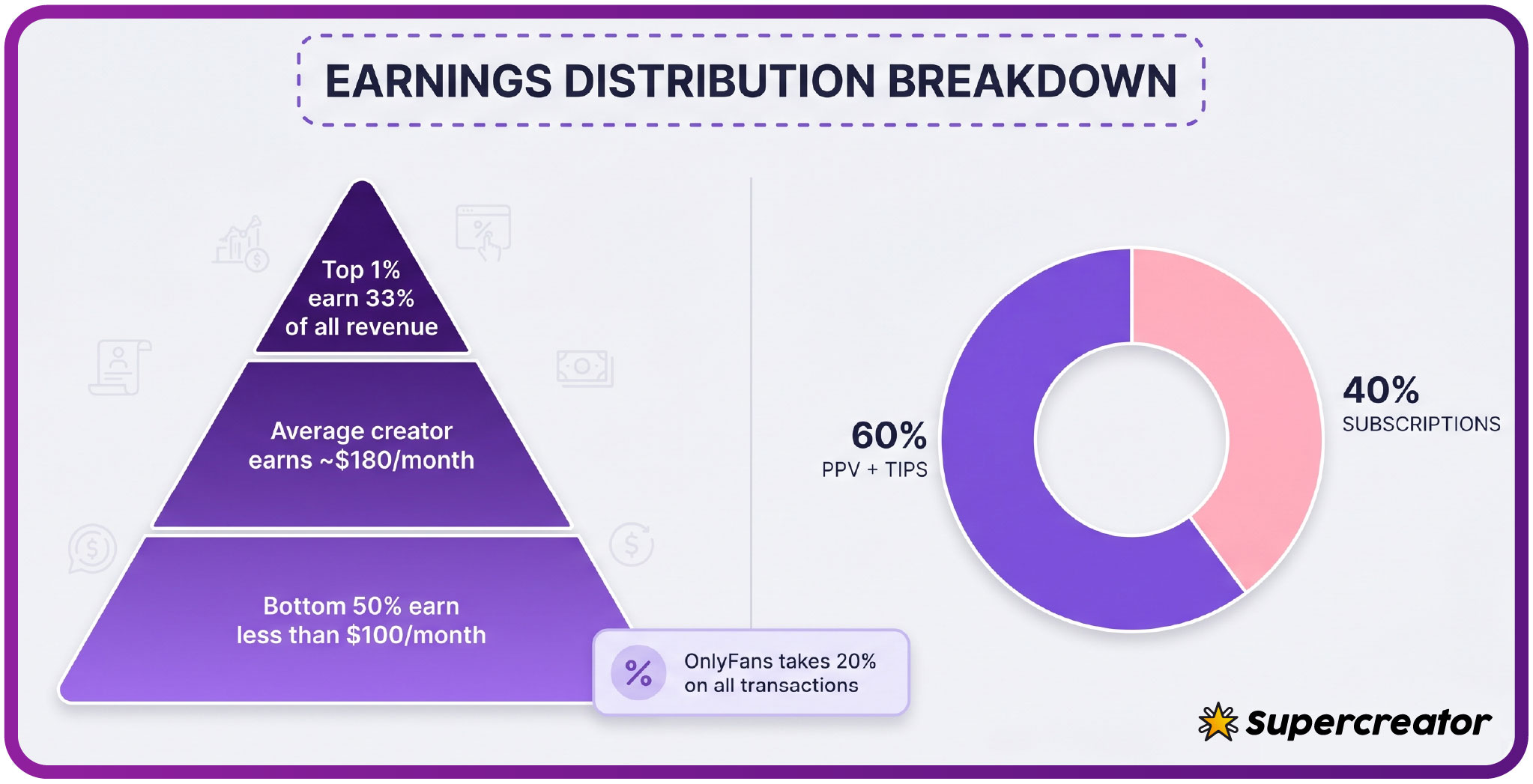
It also helps to know how the platform itself is structured. OnlyFans takes a 20% fee on everything, and the creator keeps 80%, which is why pricing across pages clusters in a narrow band between $4.99 and $15 with averages around $5-$10. Understanding that baseline makes it easier to spot a page that is genuinely expensive rather than merely unfamiliar.
FAQ
Why do I spend more on OnlyFans in month two than my first month?
Month two usually carries both a full set of renewals and the PPV activity that started late in month one. Because subscription charges and message unlocks are separate categories, the combined total is often higher than either category suggests on its own.
How can I track PPV spending when it doesn’t show as a subscription?
Keep a running tally in the same place you track renewals. A weekly total takes a few minutes and gives you a comparable number, which is the only way to see whether message spending is above or below your subscription total.
What’s the latest point where I can realistically change my OnlyFans spending habits?
Changes are easiest before month four and still workable in month five with a deliberate trigger such as a written cap. By month six the routine is established, so structural changes such as spreading renewal dates work better than relying on willpower at the moment of purchase.
Should I cancel all subscriptions and start over to reset my spending pattern?
A full reset is rarely necessary and often doesn’t hold, because the triggers remain unchanged. Auditing renewals, spreading renewal dates, and adding a wishlist delay addresses the pattern directly while keeping the subscriptions you actually use.